
Unit 1.1
Being Student-centered: Enhancing the Student Experience
NLN Competency: I
Objectives
- The learner will be able to identify the key concepts and advantages of student-centered
education. - The learner will be able to discuss how student-centered education enhances the student
experience.
Introduction
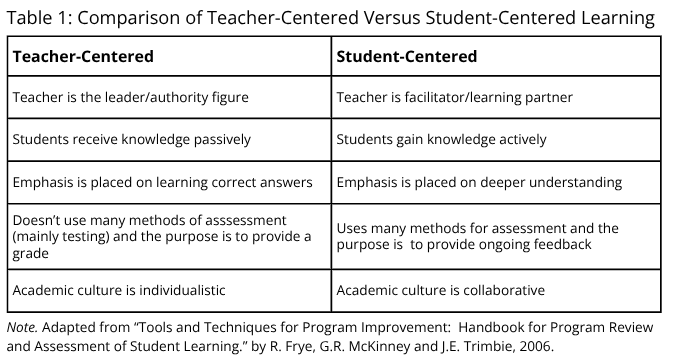
Education has traditionally been a teacher-centered experience in which educators lecture to students who passively receive information. In recent years there has been a global movement to change education to promote better learning. One of the most frequently used educational methods that can lead to better learning is student-centered learning. In student-centered learning,
students become active participants in their education, with teachers serving as facilitators who help students develop a deeper understanding of concepts and materials. This is often done by helping students see how they can use what they are learning to address problems in real-life situations. This method of education enhances the student experience by enabling students to be more engaged with what they are studying, understand why what they are studying is relevant outside the classroom, perform better in school, and feel more satisfied with their learning experience (Song, 2019; Goodman et al., 2018).
Advantages of Student-Centered Learning
- Increases student engagement, motivation, and satisfaction
- Improves academic performance
- Builds critical thinking skills
- Leads to deeper learning
- Creates life-long learners
Challenges of Student-Centered Learning
- It requires both students and teachers to examine and likely change their assumptions about what education should look like and what their roles should be in a learning environment.
- Cultural differences may make it difficult to change student/teacher roles.
- Students may initially resist student-centered learning because they do not understand it.
- May require curricula to be re-designed to facilitate a new method of education.
Implementing Student-Centered Learning
There are many ways student-centered learning can be introduced into nursing education. The following are some examples of student-centered teaching methods/activities :
- Choice in topics for study and projects
- Group discussions and open dialogue
- Buzz groups (short discussions in groups of two)
- Clinical simulation
- Role play
- Reflective journaling
- Independent projects
- Presentations by students
- Debates
- Field trips
- Peer mentoring
- Portfolio development (O’Neill & McMahon, 2005).
Conclusion
The benefits of using a student-centered learning approach in nursing education are numerous. One of the most important benefits is that it helps students become better critical thinkers – an extremely important skill in the transition from a student to a nurse who must navigate the complexities of patient care and the health system (Brown Tyo & McCurry, 2019). While there are always challenges when switching to a new method of learning/teaching, making sure that both students and teachers understand the purpose and key concepts of student-centered education can make the transition easier.
Resources
References
Brown Tyo, M., & McCurry, M.K. (2019). An integrative review of clinical reasoning teaching strategies and outcome evaluation in nursing education. Nursing Education Perspectives, 40(1), 11-17. https://doi.org/10.1097/01.nep.0000000000000375
Frye, R., McKinney, G.R., & Trimble, J.E. (2006). Tools and Techniques for Program Improvement: A Handbook for Program Review and Assessment of Student Learning. https://cpb-us-e1.wpmucdn.com/wp.wwu.edu/dist/6/3196/files/2018/08/prog_handbook-x8pnuu.pdf
Goodman, B.E., Barker, M.K., & Cooke, J.E. (2018). Best practices in active and student-centered learning in physiology classes. Advances in Physiology Education, 42(3), 417-423. https://doi.org/10.1152/advan.00064.2018
O’Neill, G., & McMahon, T. (2005). Student centred-learning: What does it mean for students and lecturers? In G. O’Neill., S. Moore & B. McMullin (Eds.), Emerging issues in the practice of university learning and teaching (pp. 27-36). AISHE.
Song, J. (2019). Learner-centered approaches in an international nurse training program. The Journal of Continuing Education in Nursing, 50(4), 183-188. https://doi.org/10.3928/00220124-20190319-09